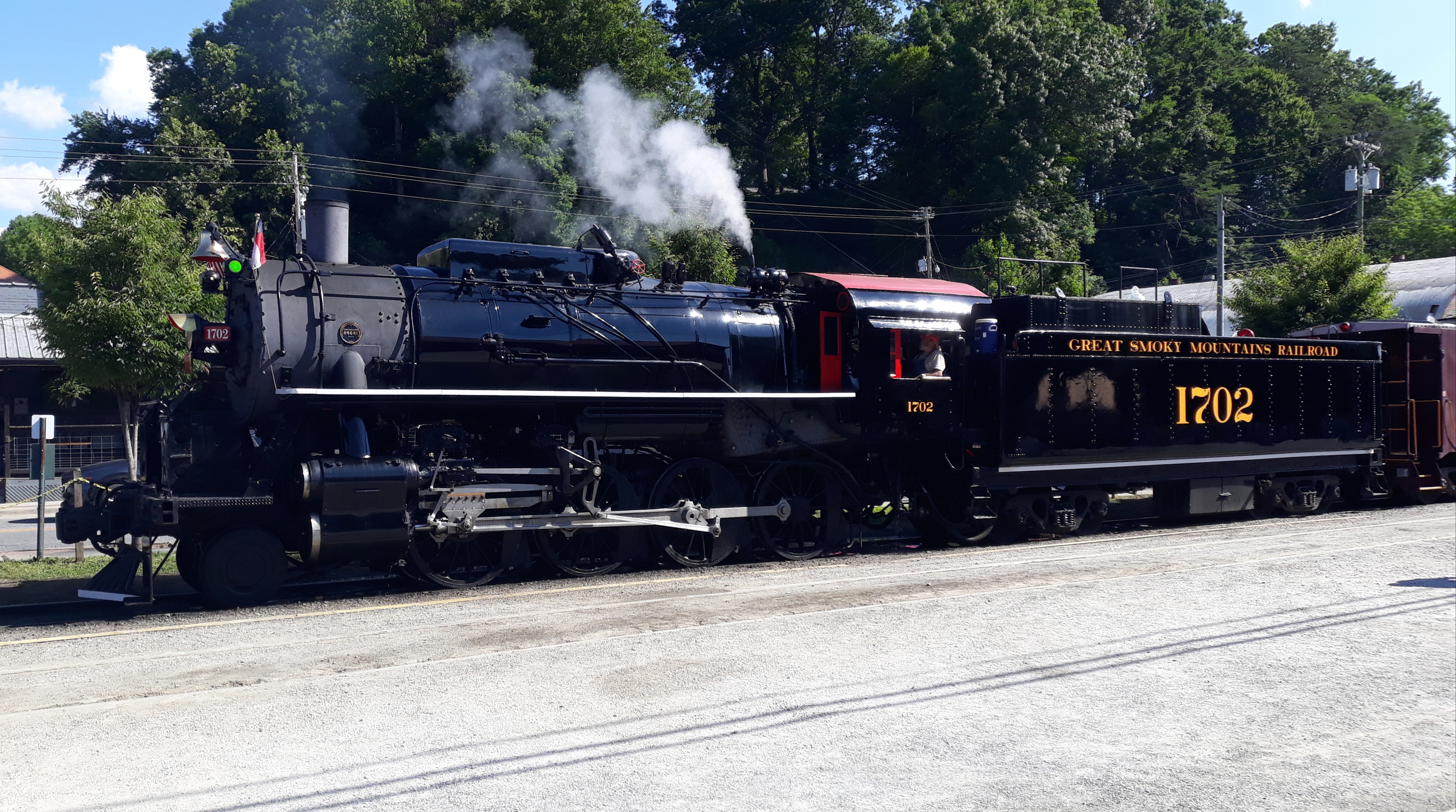
Great Smoky Mountains Railroad No. 1702
Specifications
| Road Name | Great Smoky Mountains Railroad No. 1702 (S160 class) |
| Number | 1702 |
| Original Railroad | U.S. Army Transportation Corps (S160 class); later Warren & Saline River Railroad, Reader Railroad |
| Builder | Baldwin Locomotive Works, Philadelphia, PA |
| Build Date | September 1942 |
| Wheel Arrangement | 2-8-0 (Consolidation) |
| Gauge | 4 ft 8½ in standard gauge |
| Weight | 161,000 lb |
| Tractive Effort | 31,500 lbf |
| Boiler Pressure | 225 psi |
| Driver Diameter | 4 ft 9 in (57 in) |
| Years Operated | 1942–1961 (revenue/military service); excursion service 1964–2004 and 2016–present |
| Current Status | Operational |
| Current Location | Bryson City, North Carolina |
| Current Owner | Great Smoky Mountains Railroad |
Design and Construction
No. 1702 is an S160-class 2-8-0 “Consolidation” locomotive, one of roughly 2,120 rugged, standardized war engines built to a design finalized in May 1942 by the Railway Branch of the Army’s Corps of Engineers, the forerunner of the Transportation Corps. Production was split across three builders, the American Locomotive Company, Baldwin, and Lima, with Baldwin turning out No. 1702 in Philadelphia in September 1942. Nearly 800 S160s were shipped to Great Britain under Lend-Lease to work British railways and stage for the Normandy invasion, and after the war the class scattered across Europe, North Africa, and beyond, to France, Italy, Greece, Turkey, Poland, and elsewhere. No. 1702 was originally fitted with a European-style link-and-hook coupler in anticipation of that kind of overseas service, but it never left the country, instead spending its wartime service working out of the Army base at Fort Bragg, North Carolina, where it was used for training purposes rather than front-line transport duty.
Postwar Service Across Four Railroads (1946–1985)
Sold as surplus in 1946, No. 1702 went to work for the Warren and Saline River Railroad hauling lumber trains out of Warren, Arkansas, where its firebox was converted to burn fuel oil instead of coal. When that line dieselized in 1961, the engine sat idle for a few years before the Reader Railroad in Hot Springs, Arkansas purchased it in 1964 and fitted it with a larger tender salvaged from a retired Rock Island Railroad steam locomotive. The Reader used No. 1702 for a mix of freight and, increasingly, tourist excursion work, and the engine even had a brief film career, appearing in the 1966 movie “This Property Is Condemned” alongside Natalie Wood and Robert Redford. It also pulled the last regularly scheduled mixed train, one carrying both freight and passengers together, operated anywhere in the United States, a run that continued until December 2, 1972. In 1985, No. 1702 moved on again, this time to the Fremont and Elkhorn Valley Railroad in Nebraska, hauling tourist trains over former Chicago and North Western track; Union Pacific moved the locomotive the roughly 600 miles to Nebraska at no charge, an unusual favor for a privately owned museum piece.
Purchase by Great Smoky Mountains Railroad and First Excursion Era (1991–2004)
The Great Smoky Mountains Railroad purchased No. 1702 in September 1991 and rebuilt it with a taller smokestack, a larger sand dome, and a wider cab, changes intended to give the utilitarian war-built engine a more traditional, rounded American appearance for excursion service. It entered service on the Nantahala Gorge and Tuckasegee River routes out of Bryson City, North Carolina, in June 1992, and spent the following twelve years as one of the railroad’s regular steam performers before firebox problems forced it out of active service in 2004.
Restoration and Return to Service (2014–2016)
No. 1702 sat out of service for a decade before a comprehensive rebuild got underway in 2014. Swain County, where Bryson City sits, invested roughly $700,000 in a new steam shop and turntable to support the work and to give the railroad permanent in-house capacity for future steam maintenance rather than relying on outside contractors. The rebuilt locomotive returned to active excursion service on July 26, 2016.
Recent Operations and Recognition
No. 1702 remains part of the GSMR’s active roster today, powering excursions through the Nantahala Gorge, one of the more dramatic pieces of railroad scenery in the southern Appalachians. Of the roughly 2,120 S160-class locomotives Baldwin, Alco, and Lima built during the war, only about two dozen are known to survive today, and just a handful of those are still operating under their own steam. That scarcity makes No. 1702 a rare, running link to Allied wartime rail logistics as much as it is a workhorse of the GSMR excursion fleet, a locomotive that trained soldiers at Fort Bragg, hauled Arkansas lumber and Nebraska tourists, and appeared in a Hollywood film before finding its longest-lasting home in the North Carolina mountains.