“John Bull” No. 1

Specifications
| Road Name | John Bull |
| Number | 1 |
| Original Railroad | Camden and Amboy Railroad and Transportation Company (New Jersey) |
| Builder | Robert Stephenson and Company, Newcastle upon Tyne, England |
| Build Date | June 18, 1831 |
| Wheel Arrangement | Originally 0-4-0; modified 1832 to 4-2-0 |
| Gauge | Standard gauge (4 ft 8½ in) |
| Weight | Approximately 10 short tons |
| Tractive Effort | Unknown (not calculated for this era) |
| Boiler Pressure | ~70 psi as rated |
| Driver Diameter | 4 ft 6 in |
| Years Operated | 1831 test run; 1833–1866 revenue service |
| Current Status | Preserved, static display — oldest operable self-propelled vehicle in the world (1981 demonstration) |
| Current Location | Washington, D.C. |
| Current Owner | Smithsonian Institution |
Design and Construction
The locomotive that came to be called John Bull was built in 1831 by Robert Stephenson and Company of Newcastle upon Tyne, England, ordered personally by Robert Stevens, founder of New Jersey’s Camden and Amboy Railroad and Transportation Company, during a buying trip to Britain. It was based on Stephenson’s Planet type design, delivered as an 0-4-0 with a simple four-wheel arrangement suited to the light, level track then common in England. The locomotive crossed the Atlantic disassembled aboard the ship Allegheny, arriving at Bordentown, New Jersey, on September 4, 1831, with no assembly drawings or instructions included in the shipment. Chief mechanic Isaac Dripps, who had no locomotive-building experience but had worked with steamboat machinery, rebuilt the engine essentially by working out the parts’ relationships on his own, a job he completed in about eleven days. The rebuilt locomotive, originally named Stevens and carrying roster number 1, was ready for its first test run on September 15, 1831.
Early Modifications and Entry Into Service
The Camden and Amboy’s roughly built track exposed the locomotive’s original four-wheel design to frequent derailments, so Dripps and the railroad’s shop crews modified it over the following months and years: a two-wheel leading truck was added in 1832 to guide the locomotive through curves and rail irregularities, changing its wheel arrangement to 4-2-0, and a cowcatcher, a protective cab, a headlight, and a bell followed as practical additions for American conditions that Stephenson’s original British design had not anticipated. A short demonstration run for New Jersey politicians and railroad dignitaries took place on November 12, 1831, and the locomotive entered regular revenue service in 1833 once the Camden and Amboy’s line was further along, hauling trains for the railroad for roughly the next three decades.
Name Origin
Camden and Amboy crews began referring to the engine informally as “the old John Bull,” invoking the personified figure of England much as “Uncle Sam” personifies the United States, a nickname that stuck so firmly it eventually displaced the locomotive’s original name in common usage and in the historical record.
Retirement and Early Preservation
The locomotive remained in active service for roughly 35 years before being retired around 1866, by which time the Camden and Amboy had become part of the Pennsylvania Railroad. Rather than being scrapped, it was recognized early on for its historical value: the Pennsylvania Railroad preserved the engine and put it on exhibition, most notably at the 1876 Centennial Exposition in Philadelphia and again at the 1878 National Railway Appliance Exhibition in Chicago, making it one of the first American locomotives deliberately kept and displayed as a historical artifact rather than being cut up for scrap once its working life ended.
Smithsonian Ownership and Later Exhibitions
The Smithsonian Institution acquired the John Bull in 1885, and the locomotive went on to appear at further landmark events documenting the history of American railroading, including the 1893 World’s Columbian Exposition in Chicago and the Baltimore and Ohio Railroad’s 1927 Fair of the Iron Horse pageant near Baltimore, both major public celebrations of railroad history that drew on historic equipment from collections around the country.
1981 Operating Demonstration
The locomotive’s best known moment in the modern era came in 1981, when the Smithsonian marked the 150th anniversary of its original 1831 test run by returning the John Bull to steam and operating it under its own power on a length of track in the Washington, D.C. area. The demonstration made it, at the time, the oldest operable self propelled vehicle in the world, a distinction it still holds. The run was treated as a one time commemorative event rather than the start of ongoing operation, and the locomotive has not run under its own power since.
Current Status
The John Bull remains in the collection of the Smithsonian’s National Museum of American History in Washington, D.C., where it is preserved in static, display ready condition. Though it has not operated since the 1981 anniversary run, museum staff have described the mechanism as still serviceable, and the locomotive is treated less as a static prop than as a working machine that happens to be resting, a distinction the Smithsonian has periodically underscored by pointing to the 1981 run as proof of the engine’s continued mechanical soundness.
Recognition
The John Bull is widely recognized by railroad historians and the Smithsonian itself as the oldest complete, substantially original steam locomotive in the United States and the oldest operable self propelled vehicle of any kind in the world, a title earned by the 1981 demonstration run and unchallenged since. Its early adoption for preservation, more than a decade before most American railroads gave any thought to saving retired equipment, also makes it one of the foundational objects in American railroad history collecting.
Blueprint / Diagram
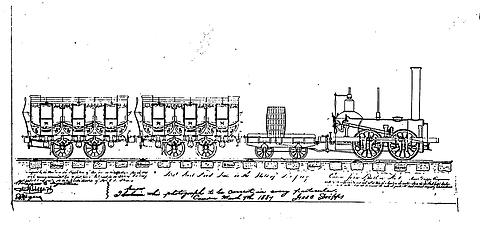
Source: Historical sketch by Isaac Dripps, 1887 (public domain) — a retrospective illustration, not an original builder's technical drawing