Norfolk & Western “Spirit of Roanoke” No. 611

Specifications
| Road Name | Spirit of Roanoke |
| Number | 611 |
| Original Railroad | Norfolk and Western Railway |
| Builder | Norfolk & Western Railway, Roanoke Shops |
| Build Date | May 29, 1950 |
| Wheel Arrangement | 4-8-4 (Class J) |
| Gauge | Standard gauge (4 ft 8½ in) |
| Weight | 872,600 lb total (locomotive 494,000 lb, tender 378,600 lb) |
| Tractive Effort | 80,000 lbf |
| Boiler Pressure | 300 psi |
| Driver Diameter | 70 in |
| Years Operated | 1950–1959 |
| Current Status | Operational excursion service — Virginia's official state steam locomotive |
| Current Location | Roanoke, Virginia |
| Current Owner | Virginia Museum of Transportation |
Design and Construction
No. 611 was the twelfth of fourteen Class J 4-8-4 locomotives Norfolk and Western built for itself at its own East End Shops in Roanoke, Virginia, entering service on May 29, 1950 at a construction cost of roughly $251,000. Where most American railroads bought their steam power from outside builders like Baldwin or Alco, N&W designed and built the Js in-house, and it showed: the class used roller bearings on every rod and axle rather than traditional friction bearings, cutting maintenance time and letting the locomotives run longer between shoppings. Streamlined side skirting and a bullet-nosed smokebox gave the class its distinctive look, but the styling wasn’t just cosmetic: N&W’s own wind-tunnel testing at Langley shaped the shrouding to reduce drag at speed. Riding on 70-inch drivers and rated at roughly 5,100 horsepower, the Js were built to run heavy passenger trains fast over N&W’s mountainous main line between Norfolk and Cincinnati, terrain that would have humbled most other railroads’ passenger power.
Revenue Service (1950–1959)
611 spent its working career on N&W’s premier name trains, the Powhatan Arrow, the Pocahontas, and the Cavalier, hauling first-class passengers across a railroad that, unusually for the era, kept investing in steam well after most Class I railroads had committed to diesel. In 1956, 611 was seriously damaged in a wreck and sent back to the Roanoke shops that built it for a full rebuild, returning to service the following year. By the back half of the decade, though, N&W’s own dieselization program had caught up with its steam fleet regardless of how well the Js performed, and 611 pulled a farewell-to-steam excursion in 1959 before being retired from revenue service.
First Retirement and Museum Years (1959–1981)
Rather than being scrapped like most of its sister locomotives, 611 was donated to the Virginia Museum of Transportation in Roanoke in the early 1960s, effectively becoming a static lawn ornament for the next two decades. It wasn’t an isolated honor for long: in 1984 the American Society of Mechanical Engineers designated the Class J a National Historic Mechanical Engineering Landmark, one of a relatively small number of individual locomotives to carry that distinction.
First Excursion Era (1982–1994)
In 1981, Norfolk Southern president Robert Claytor, whose father had championed 611’s preservation in the first place, authorized leasing the locomotive back from the museum and returning it to steam. Southern Railway’s steam shop at Norris Yard in Birmingham, Alabama handled the overhaul, and 611 returned to the rails in 1982 as the flagship of Norfolk Southern’s newly launched steam excursion program, eventually running trips as far afield as a St. Louis-to-Moberly, Missouri route in Southern’s own former territory. Over thirteen seasons, 611 logged runs across much of the eastern half of the country, but the program wasn’t without incident: excursion trains it was pulling derailed twice, once in the spring of 1986 and again in the fall of 1994. Rising insurance costs following the second derailment, combined with the broader expense of running a mainline steam program, led Norfolk Southern to shut the whole operation down in 1994, and 611 went back into retirement at the Virginia Museum of Transportation.
Second Retirement (1994–2013)
611 spent the next two decades as a museum centerpiece in Roanoke rather than a working locomotive, its condition maintained but its fire cold. Interest in bringing it back never fully went away, and by the early 2010s a small group of volunteers and museum supporters began pushing seriously for a second restoration.
The Fire Up 611! Restoration (2013–2015)
The Virginia Museum of Transportation formally announced the Fire Up 611! Committee on February 22, 2013, first to study whether a second restoration was even feasible and then, once the study came back favorable, to actually fund and execute it. The project needed roughly $3.5 million to cover both the mechanical overhaul and a new maintenance facility to house the locomotive going forward. Norfolk Southern contributed $1.5 million toward the effort, funded in part through the auction of a Mark Rothko painting from its corporate art collection, and roughly 3,000 individual donors contributed close to $1 million more, an unusually broad grassroots base for a restoration this size. The mechanical work itself was done at the North Carolina Transportation Museum’s Spencer Shops, a full teardown-and-rebuild to current Federal Railroad Administration mainline standards rather than a cosmetic refresh. 611 moved under its own power again in the spring of 2015.
Second Excursion Era and 21st Century Steam (2015–2017)
611’s return coincided with Norfolk Southern’s 21st Century Steam program, a multi-year initiative pairing 611 and other preserved steam locomotives with mainline excursions across the NS system. Over the life of the program 611 pulled trips through Virginia, North Carolina, West Virginia, and beyond, reintroducing an entire generation of railfans to what a Class J actually sounded and looked like doing the job it was designed for. In May 2017, Virginia’s General Assembly designated 611 the Commonwealth’s official steam locomotive, formal recognition of a machine that had by then spent more of its life as a public symbol than as ordinary railroad equipment.
Recent Operations (2018–Present)
Norfolk Southern wound the 21st Century Steam program down in 2017, and since then 611 has operated less as a dedicated mainline excursion locomotive and more as a traveling exhibit, moving between host railroads for shorter runs. It has made repeat appearances at Strasburg Rail Road in Pennsylvania (including a well-attended “farewell tour” run there in May 2023), constrained in part by Positive Train Control requirements that limit where a non-PTC-equipped steam locomotive can legally operate on current Class I track. In fall 2023, 611 found a new home for extended excursion service on the Virginia Scenic Railway, operated by Buckingham Branch Railroad, running trips through the George Washington and Jefferson National Forests between Goshen and Staunton, Virginia, its first fall excursion season back in home-state territory since 1994. The Virginia Museum of Transportation in Roanoke remains its legal owner and home base between assignments.
Recognition
Beyond its state designation and ASME landmark status, 611 is listed on the National Register of Historic Places and is widely regarded by railroad historians as the best-preserved example of what many consider the most advanced steam passenger locomotive design ever built in North America, a status it holds partly on engineering merit and partly by default, since it is the sole surviving Class J of the fourteen N&W built.
Blueprint / Diagram
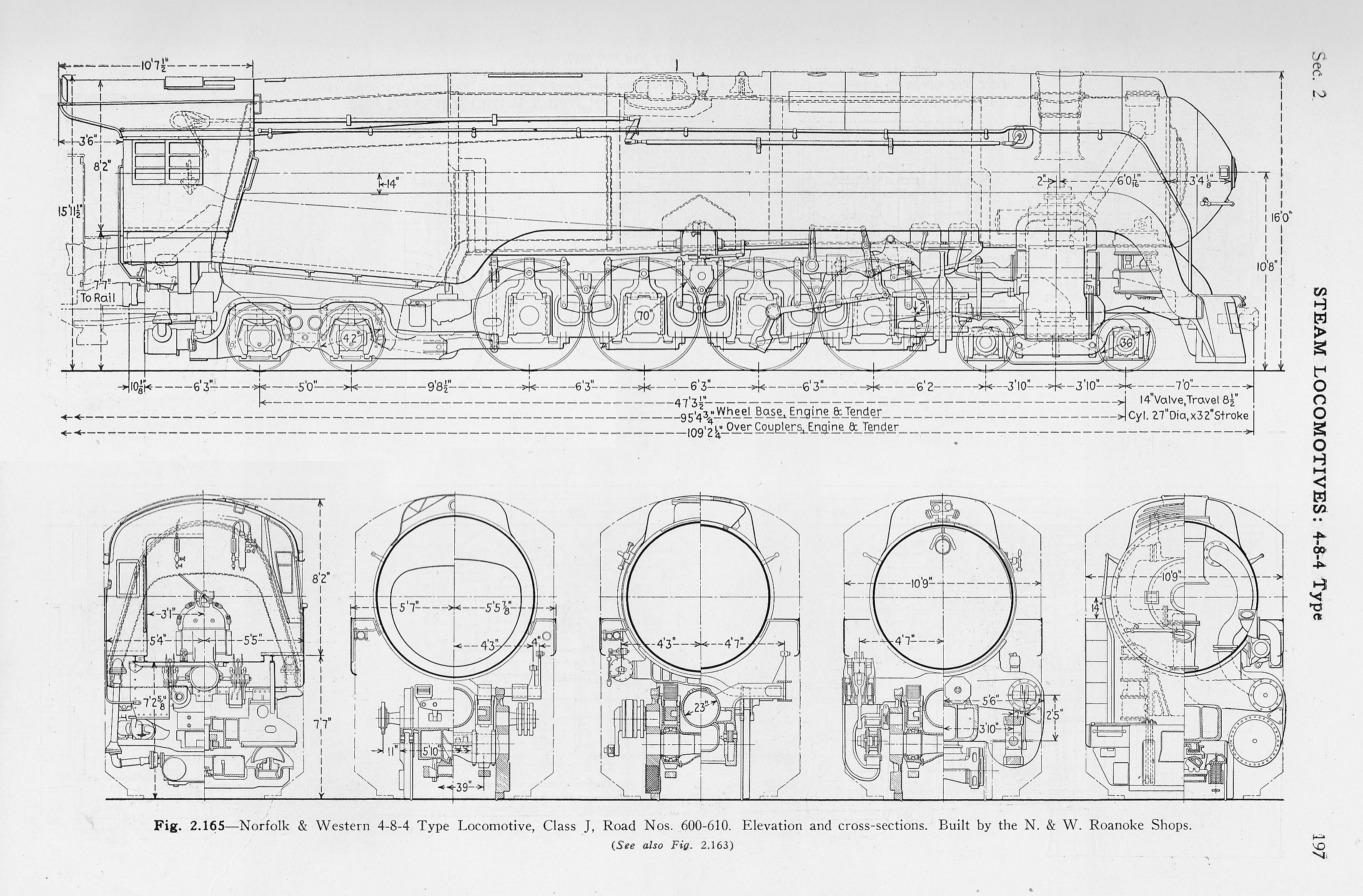
Source: 1941 Class J general diagram (CC0) — depicts the class generally, not this specific 1950-built locomotive