White Pass & Yukon Route No. 69
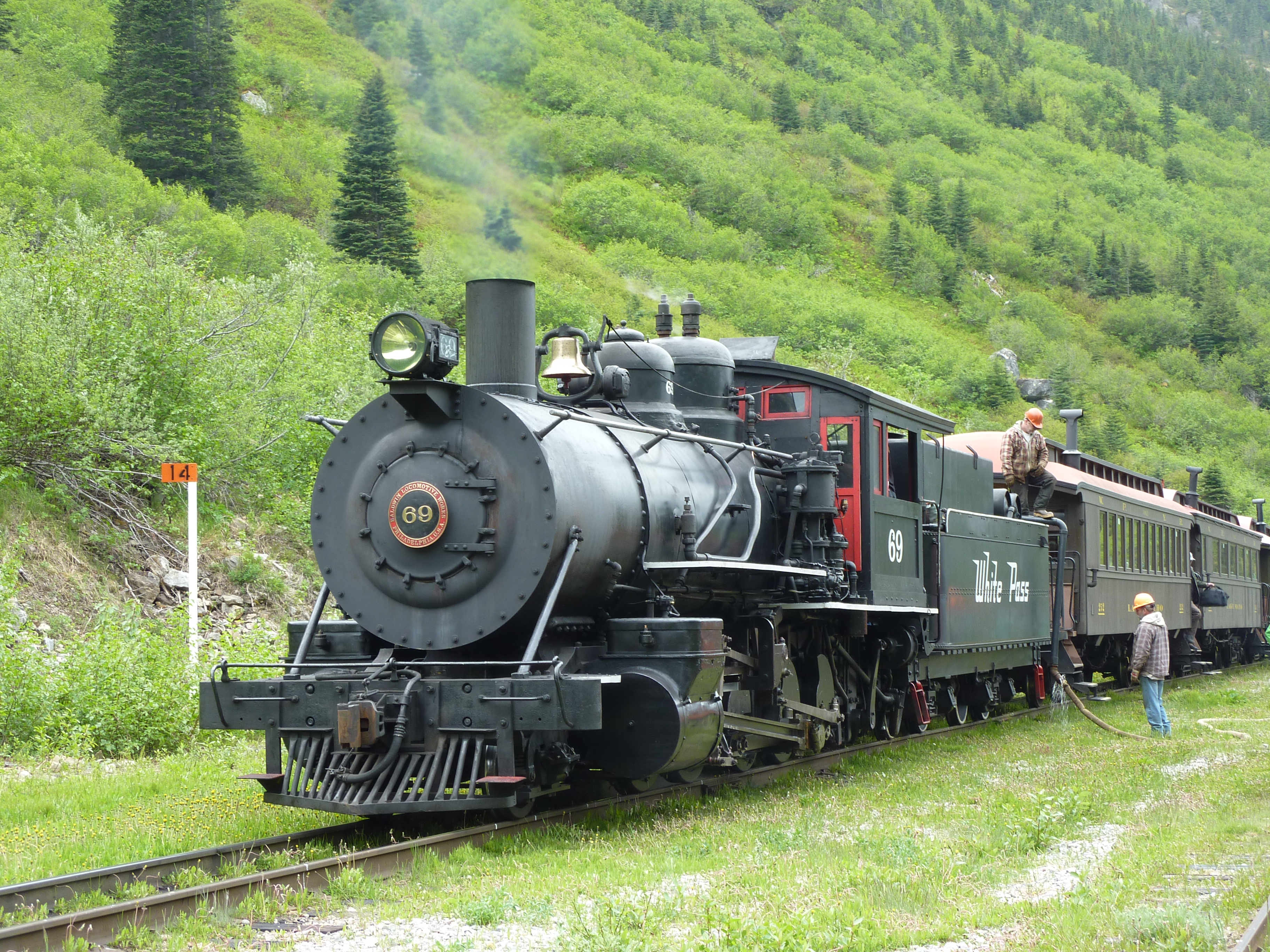
Specifications
| Road Name | White Pass & Yukon Route No. 69 (“Bull of the Woods”) |
| Number | 69 |
| Original Railroad | White Pass & Yukon Route |
| Builder | Baldwin Locomotive Works, Philadelphia, PA |
| Build Date | June 1908 |
| Wheel Arrangement | 2-8-0 (Consolidation) |
| Gauge | 3 ft narrow gauge |
| Weight | 134,000 lb |
| Tractive Effort | 31,400 lbf |
| Boiler Pressure | 160 psi |
| Driver Diameter | 42 in |
| Years Operated | 1908–1954 (revenue service); excursion service 2006–present with WP&YR (also ran 1957–2001 on other tourist lines) |
| Current Status | Undergoing FRA 1,472-day inspection/overhaul (out of service) |
| Current Location | Skagway, Alaska |
| Current Owner | White Pass & Yukon Route |
Design and Construction
No. 69 is a narrow gauge 2-8-0 “Consolidation” built by the Baldwin Locomotive Works in June 1908, serial number 32962, for the White Pass and Yukon Route. At roughly 134,000 pounds it was, at the time, one of the heaviest narrow gauge, outside-frame locomotives Baldwin had built, engineered to work grades as steep as 3.9 percent and curves as tight as 20 degrees on the line between Skagway, Alaska, and Whitehorse, Yukon. Engineer J.D. True gave it the nickname “Bull of the Woods” for its pulling power, a name that stuck with the locomotive for the rest of its career.
Revenue Service and the 1932 Roundhouse Fire
No. 69 hauled both freight and passenger trains for WP&YR for roughly three decades. On February 12, 1932, a fire tore through the railway’s Skagway roundhouse and badly damaged three other locomotives housed there; No. 69 escaped with comparatively minor damage and was repaired and back in service by that August, while the roundhouse itself had to be rebuilt from the ground up. In 1951 the locomotive was converted from coal to oil firing.
Wartime Service and the Alaska Highway (1942–1945)
During World War II, No. 69 was pressed into U.S. Army Transportation Corps service supporting construction of the Alaska Highway, hauling materials, troops, and equipment over the WP&YR line as the Army raced to build an overland supply route to Alaska. Crews picked up a second nickname for the engine during this stretch, “Gila Monster,” alongside its older “Bull of the Woods” moniker.
Retirement and a Second Career on the Mainland (1954–2001)
WP&YR retired No. 69 from revenue service in 1954 as the railway began shifting toward diesel power. Rather than sitting idle, the locomotive began a long second career far from Alaska: the Black Hills Central Railroad in South Dakota acquired it in 1956 and used it to pull that tourist line’s very first excursion train on August 18, 1957, running under yet another adopted nickname, “Klondike Casey.” It later moved to the Nebraska Midland Railroad in North Platte in 1973, and from there passed to Nebraska’s Stuhr Museum, where it sat retired from excursion service by 1990.
Return to White Pass and Restoration (2001–2006)
In June 2001, the White Pass and Yukon Route reacquired its old engine, trading passenger equipment to the Stuhr Museum to get No. 69 back to Alaska after nearly half a century away. Restoration took several years; the boiler was successfully test-fired in 2005, and No. 69 returned to excursion service at Skagway in September 2006, more than seven decades after it first went to work on the same line.
Recent Operations and Current Status
Since its return, No. 69 has run alongside sister locomotive No. 73 as one of WP&YR’s two operating steam engines, occasionally doubleheading with it on busier excursion days over a railway that climbs almost 2,900 feet from sea level at Skagway to the White Pass summit in only 20 miles, terrain that explains why the line was jointly designated an International Historic Civil Engineering Landmark in 1994. No. 69 is currently out of service in Skagway undergoing its mandated Federal Railroad Administration 1,472-day inspection and overhaul, the same periodic mainline certification process that has sidelined No. 73 in past years, and it is expected to return to the excursion roster once that work is complete.
Recognition
No. 69’s working life is unusual even by the standards of preserved steam power: built for one narrow gauge railway in 1908, it went on to inaugurate excursion service on a second, the Black Hills Central, in 1957, ran on a third in Nebraska, sat retired at a museum for over a decade, and then came home to the line it started on after nearly fifty years away. Few surviving steam locomotives anywhere have worked, under their own name or under an adopted nickname, on as many different railroads across as many decades as the engine once called the Bull of the Woods.